Site visit vs desk due diligence for Tamil Nadu land
What a records check and a field visit each catch on Tamil Nadu land, where they disagree, and how land teams sequence and log both before an advance.
Vignesh Nagarajan · · 13 min read · Source: Registration Department, Government of Tamil Nadu
On this page
- In short
- What desk due diligence covers
- What a site visit covers
- Side by side: what each one catches
- Test the FMB sketch against the ground
- Access and approach road
- Encroachment, occupation and possession
- Land classification and use on the ground
- Keep one mismatch log when the two disagree
- Run the desk check, then the visit, then the desk again
- Evidence to keep from each
- Who should do what on the team
- What this means for you
This post is for land teams and plot buyers in Tamil Nadu who are about to pay an advance, and for sellers getting ready for their checks. It compares what a records check and a site visit each catch, and it is not legal advice or a title opinion.
In short
- You need both. The desk check shows what the registration and revenue records say about a parcel. The site visit shows what is on the ground today.
- A records check cannot show who occupies the land or how it is reached. A visit cannot show title, registered charges or the revenue entry.
- Many problems only show up where the two disagree, so the useful output is one list of mismatches, not two reports.
- When the ground and the FMB sketch disagree, log it and have a qualified surveyor relate the record to the site. The public sketch alone does not identify the cause.
- Run the desk check, then the visit, then the desk again. Pay an advance only when every open row in the mismatch log has an owner and a plan.
What desk due diligence covers
Desk due diligence is the records check you can run from the office. In Tamil Nadu it rests on four records: the registered deed chain, the Encumbrance Certificate, the Patta-Chitta extract and the FMB sketch, with the A-Register for rural parcels. Each answers a different question, and none of them alone proves marketable title.
| Record | What it shows | What it does not prove |
|---|---|---|
| Encumbrance Certificate | Registered and indexed entries for the property, Sub-Registrar Office and period searched | That the identifiers, period or jurisdiction were complete |
| Patta-Chitta | The revenue-record holder, survey number, subdivision, area and land classification | Marketable title on its own |
| FMB sketch | Recorded geometry, measurements, subdivision and adjoining survey references, where shown | Ownership, current occupation or the boundary on the ground |
| A-Register | Survey, subdivision, area, classification and related revenue details for a rural parcel | Title, without the deed chain and EC |
| Deed chain | How the interest passed from owner to owner | That no unregistered claim exists |
The desk check is where you learn what the seller is entitled to sell. It is also where you collect the identifiers the site team will need: district, taluk, village, survey number and subdivision. Confirm the Encumbrance Certificate on TNREGINET, and the Patta-Chitta, FMB sketch and A-Register on Tamil Nadu eServices.
What a site visit covers
A site visit checks the parcel itself. It confirms that the land exists where the records place it, that it can be reached, and that nobody else is using it. The site visit checklist groups 25 checks into preparation, physical assessment, neighbourhood and access, utilities, and documentation on site.
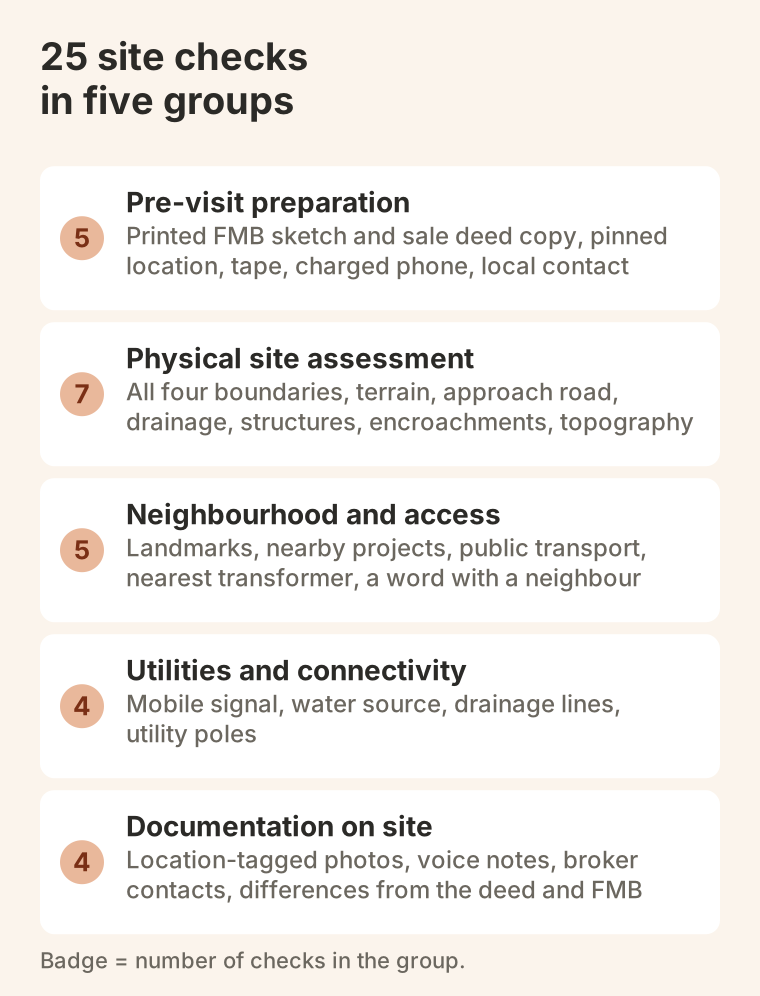
The last group matters most. A visit that does not write down where the ground differs from the papers has produced photos, not evidence.
Side by side: what each one catches
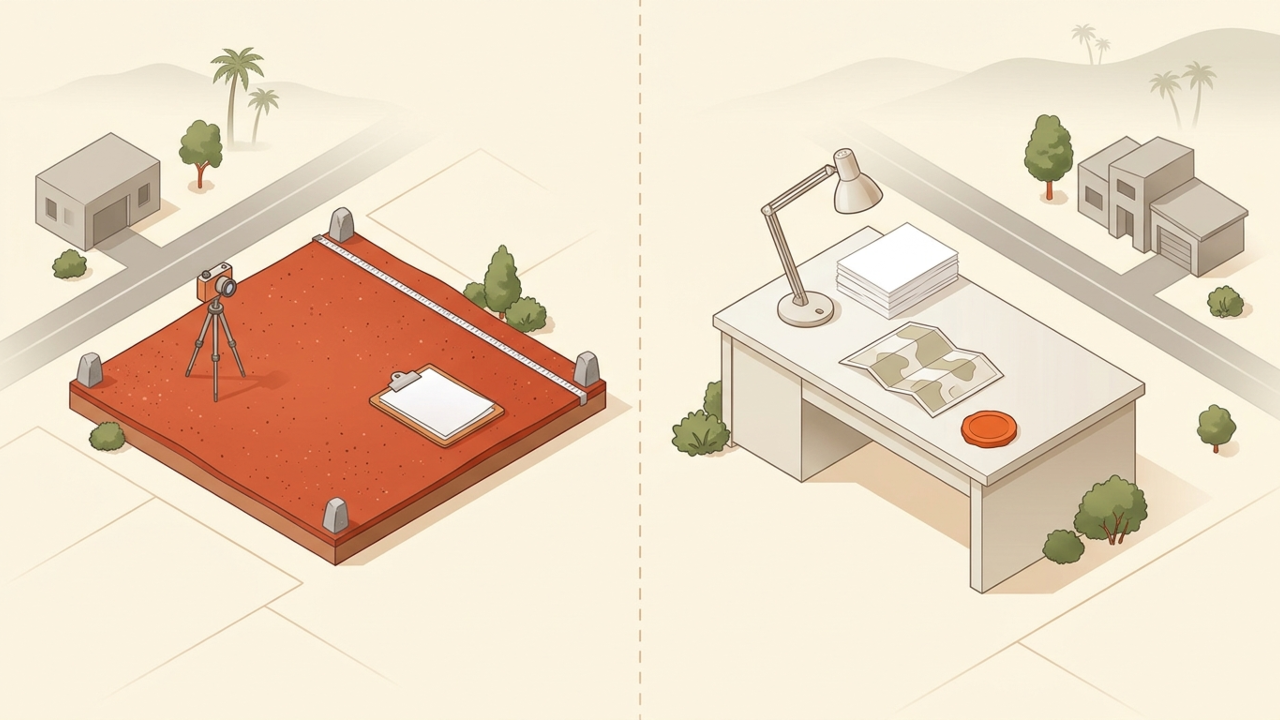
Each check has blind spots that the other covers. The chart shows which one is more likely to surface each problem first.
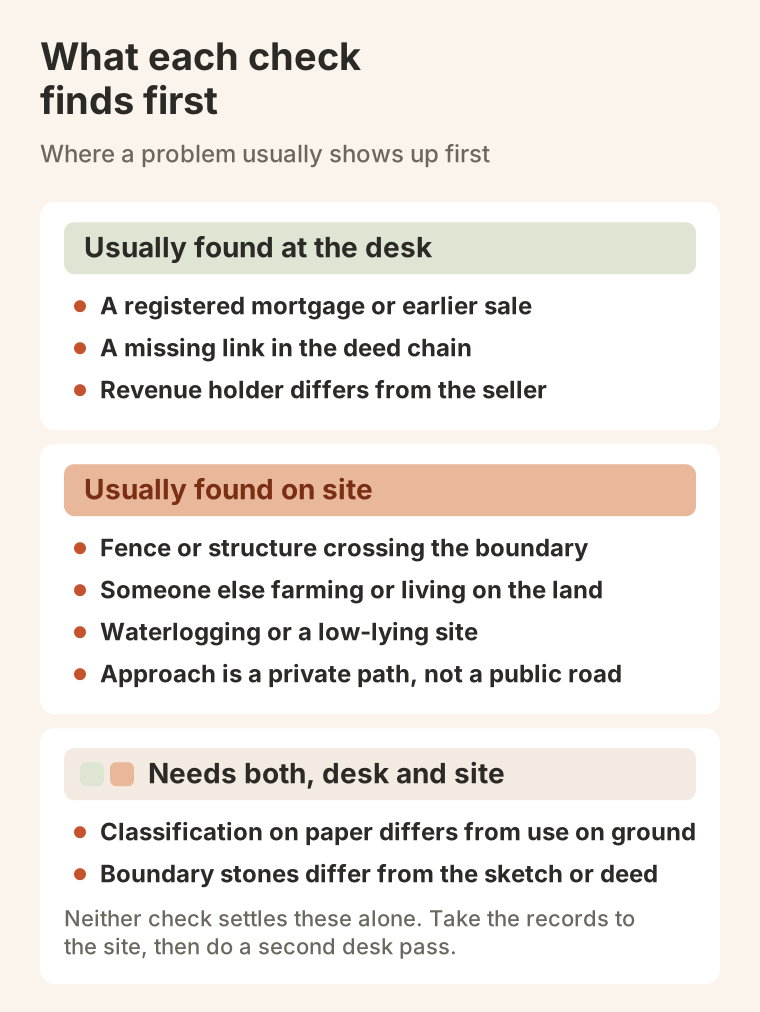
The problems that need both are the ones to plan for. They need the records in hand at the site, and a second desk pass afterwards.
Test the FMB sketch against the ground
The FMB sketch is the record most often tested on site. It is parcel-level survey evidence, but it does not by itself prove the exact boundary on the ground. A mismatch can come from a wrong identifier, units, a subdivision, a later survey action, occupation, the measurement method or a record error, and the public sketch alone does not say which.
| On-site observation | Desk record to compare | Next step |
|---|---|---|
| Frontage or depth differs from the sketch | FMB sketch measurements | Recheck the survey number and subdivision used |
| Boundary stones missing or moved | FMB sketch and adjoining references | Ask a qualified surveyor to relate record to site |
| Plot is split by a fence not shown on the sketch | FMB sketch, Patta-Chitta subdivision | Look for a later subdivision or resurvey |
| Adjoining parcel references differ | FMB sketch and deed schedule | Document the variance and seek survey advice |
Pull the sketch through the FMB and TSLR sketch search before the visit (a rural or Natham FMB, or an urban TSLR sketch), and carry a printed copy. Use the exact survey number and subdivision from the deed or the current revenue record. Do not guess or silently translate an older identifier.
Move on when each difference from the sketch has a cause, a survey note or an open row in the mismatch log.
Access and approach road
Access is a site question first. Records may not settle whether the approach is a public road, a cart track across someone else’s land, or a path the seller uses by arrangement. The visit should measure the road, note its surface, and record where it joins a public road.
| What to record on site | Why it matters at the desk |
|---|---|
| Road width and surface | The access the deed describes should match what you find |
| Whether the road crosses another parcel | A right of way may need to be documented in the deed chain |
| Where the road meets a public road | Shows whether the road physically joins a public road, to compare with the deed’s access description |
| Gates, chains or locked entries | Suggests the access is controlled by someone else |
If the deed schedule describes access that you cannot find on the ground, treat it as an open item. Ask for the document that creates the right of way before the advance.
Encroachment, occupation and possession
Occupation is the clearest case where only a visit will tell you. An Encumbrance Certificate reports registered and indexed entries. It does not show a tenant, a relative farming the land, or a neighbour’s wall that crossed the line years ago. The visit is where these surface.
| Sign seen on site | What to ask |
|---|---|
| Standing crop or cattle | Who is farming it, and under what arrangement |
| A house, shed or well | Who built it, and is it in the deed schedule |
| A neighbour’s fence inside the boundary | How long it has stood, and has anyone objected |
| Fresh earthwork or dumped debris | Who did it, and is someone preparing to claim use |
Record each sign with a location-tagged photo and a note. Then take it back to the desk and to counsel. Possession does not settle ownership, so a clean visit does not replace the title check either.
The checklist also asks the team to talk to at least one neighbour about the plot’s history, disputes and reputation. What you hear is not evidence of title, but it tells you where to look:
- A family dispute over the land: check the deed chain, legal heirship and litigation searches.
- An earlier sale “that fell through”: check the Encumbrance Certificate and any registered agreement.
- A boundary quarrel: check the FMB sketch, adjoining references and a surveyor.
- A government notice in the village: check acquisition and planning records for the area.
Write down what was said, by whom in role terms, and the date. Then treat each point as a lead for the desk check, not as a finding.
Land classification and use on the ground
The revenue record carries the land classification, and the A-Register can flag land types that need extra care. The visit shows how the land is actually used. When the two differ, neither one is automatically right.
| Record says | Ground shows | Treat as |
|---|---|---|
| Wetland (nanjai) | Dry, unirrigated land | Open item; ask the revenue office |
| Dry land | A tank bund or channel crossing the plot | Open item; check survey and revenue records |
| Private holding | A path, pond or common used by villagers | Possible poramboke; stop and check |
| Agricultural use | Buildings or a layout on the land | Check conversion and planning approvals |
A poramboke entry is government land that cannot be sold or transferred for private ownership. If the visit suggests common use, check the A-Register and Patta-Chitta before anything else.
Keep one mismatch log when the two disagree
The most useful output of the pair is a single mismatch log. Each row ties one site observation to one record, says who owns the follow-up, and stays open until evidence closes it. This keeps a mismatch from being lost between the field team and the legal team.
| Column | What goes in it |
|---|---|
| Parcel | District, taluk, village, survey number and subdivision |
| Observation | What the site showed, with photo reference |
| Record | Which record it conflicts with, and the retrieval date |
| Possible causes | Wrong identifier, later subdivision, occupation, record error |
| Owner | The person on the team responsible for the follow-up, by role |
| Status | Open, resolved with evidence, or escalated to counsel |
Do not close a row on a verbal assurance from the seller. Close it on a document, a surveyor’s note or counsel’s opinion.
Run the desk check, then the visit, then the desk again
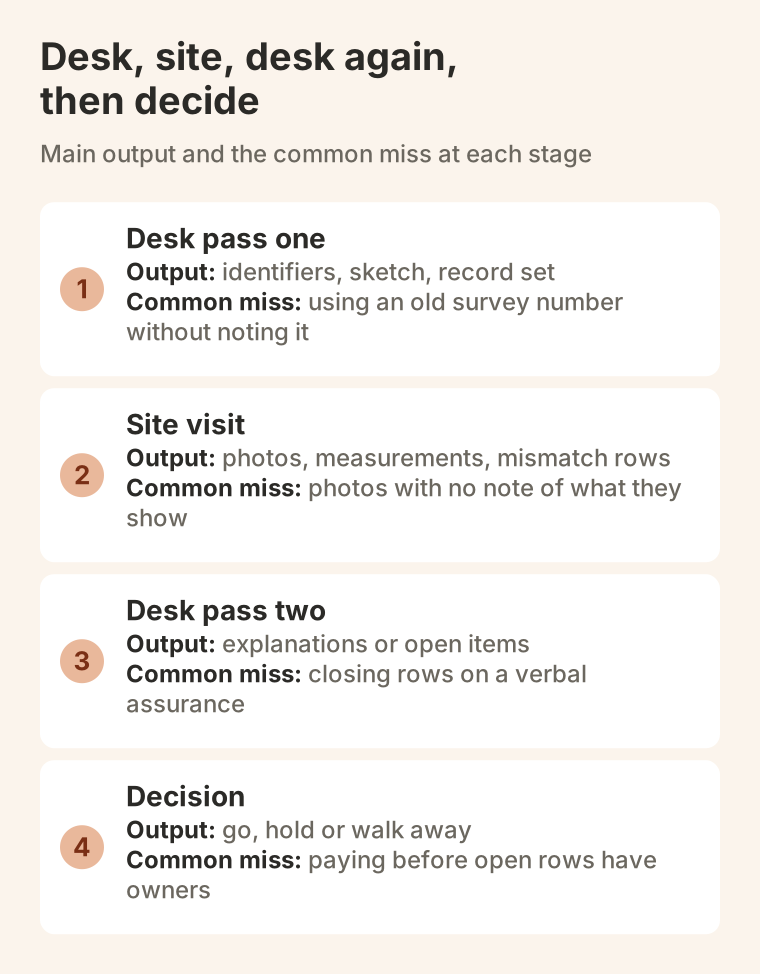
Run the desk check first, then the visit, then a second desk pass. The first pass gives the visit team the identifiers and sketch. The second pass chases every mismatch the visit raised.
- Desk pass one. Pull the Patta-Chitta, FMB sketch, A-Register where it applies, and an Encumbrance Certificate for the period counsel defines. Use the Encumbrance Certificate search and keep the exact search inputs with the result.
- Site visit. Carry the printed sketch and deed copy. Work through the site visit checklist and log every difference from the records.
- Desk pass two. Recheck identifiers, look for later subdivisions or resurveys, and pull any record the visit pointed to.
- Decision. Pay an advance only when every open row in the mismatch log has an owner and a plan.
Evidence to keep from each
For records, keep the exact inputs and the retrieval date. For the visit, keep photos that show what they claim to show, so that someone who was not there can follow your reasoning.
| Desk evidence | Site evidence |
|---|---|
| Each record with its search inputs and retrieval date | Location-tagged photos of each boundary |
| The EC search offices and period, and who set them | Measurements of frontage, depth and approach road |
| The deed chain, with gaps marked | Notes on occupation, structures and use |
| The FMB sketch used on site | The same sketch, marked up with differences |
| Counsel’s notes on open items | Voice notes and the visit date and team, by role |
The document readiness checker helps track which records are in hand. The land due diligence checklist tracks the wider title, zoning, survey, access and approval checks.
Who should do what on the team
Records work suits whoever handles documents and liaises with counsel. Site work suits someone who knows the area and can measure, photograph and talk to neighbours. The mismatch log is shared.
| Role | Desk due diligence | Site visit |
|---|---|---|
| Land acquisition lead | Sets the record set and search scope | Decides when a visit is needed |
| Field executive | Supplies identifiers from the seller | Runs the checklist and logs mismatches |
| Documentation executive | Pulls and files records | Prints the sketch and deed for the team |
| Surveyor | Reads the sketch and survey history | Relates the record to the ground |
| Counsel | Reviews title and open items | Reviews possession and access findings |
For the title side of this work, read the guide to verifying land ownership before buying and the warning signs in land records. For a parcel you have already bought, the guide to patta mutation after purchase covers the revenue-record update.
What this means for you
If you run land acquisition for a developer: pull the records first, send the field team to the site with the printed FMB sketch and deed copy, then run a second desk pass on every mismatch. Do not release an advance while a mismatch row has no owner.
If you are buying a single plot: a clean Encumbrance Certificate does not show who occupies the land, and a visit does not show title. Do both, and close each mismatch on a document, a surveyor’s note or counsel’s opinion, not on the seller’s word.
If you are selling land: have the survey number, subdivision, deed chain and sketch ready, and know how the approach road is documented. A buyer’s site team will compare the ground with them.
Sources and editorial notes
Methodology
This comparison is built from the record definitions and red flags on the site's reviewed Tamil Nadu record pages and from the site-visit checklist tool. It states no fee, period, rate or turnaround, and it names TNREGINET and Tamil Nadu eServices as the official places to confirm the records.
Sources
- TNREGINET portal: Encumbrance Certificate search and registration services — Registration Department, Government of Tamil NaduPrimary source · Checked
- Tamil Nadu eServices: Patta-Chitta, A-Register and FMB sketch records — Government of Tamil NaduPrimary source · Checked
Questions
Take the checklist to the site
Work through the field checks and note where the ground differs from the deed and FMB sketch.
Continue reading
Sale Deed vs. Agreement to Sell: What a Land Buyer Really Gets
What an agreement to sell and a sale deed each secure, Tamil Nadu registration rules, EC searches, mutation, and your options if the seller defaults.
WhatsApp for Land Deals: Define Its Role
What a land team can keep in WhatsApp, and which parcel decisions, files and approvals must be copied into the parcel record.
Land Acquisition Software India: How to Choose in 2026
Which kind of land acquisition software fits your work: LAMS, ERP, CRM, spreadsheet or Proquiro, with a fair pilot to test them. Pages checked 9 August 2026.