OSR in Tamil Nadu: open space reservation rules for land teams
How open space reservation works under TNCDBR 2019: the size slabs, land or payment, gift deeds, other layout shares, regularisation and the 2025 Supreme Court ruling.
Vignesh Nagarajan · · 24 min read · Source: Government of Tamil Nadu
On this page
- In short
- Where the OSR rules sit
- The three size slabs
- How the land reservation is measured
- Paying instead of reserving land
- Minimum size, width and number of parcels
- Gift deed and timing
- Other shares a layout must set aside
- Buildings, additions, institutional and industrial sites
- Old layouts, Annexure XX and the 2025 Supreme Court ruling
- Regularisation of unapproved layouts
- OSR in land acquisition due diligence
- Common OSR mistakes
- What this means for you
This guide is for land teams, developers and land owners weighing a layout or a large site in Tamil Nadu. It explains how open space reservation (OSR) works under the Tamil Nadu Combined Development and Building Rules, 2019 (TNCDBR), as amended, and what to check before you buy. It is not legal advice, and the planning authority has the final word on any site.
In short
- OSR is land a development or layout must keep open as a park or playground. Rule 41 of TNCDBR 2019 sets it for developments, including buildings, and Rule 47(6) sets it for layouts and sub-divisions.
- The first 3,000 sqm carries no reservation. Between 3,000 and 10,000 sqm, the owner reserves 10% of the area excluding roads or pays the guideline value of the equivalent land, excluding the first 3,000 sqm. Above 10,000 sqm, the 10% must be reserved as land.
- Where land is reserved, it goes to the local body free of cost by registered gift deed. For a layout, that happens before the actual sanction of the layout, together with the roads other than private ones. Government industrial estates may be allowed to retain them.
- A layout hands over more than OSR: a further 1% for public purposes in all layouts. Residential layouts above 10,000 sqm must also develop 10% as EWS plots, sold only for that purpose.
- Since 2020, OSR need not be insisted on for institutional and industrial developments abutting a public road. Single buildings get no blanket exemption.
- TNCDBR has no OSR exemption for land that pre-dates a master plan, and its Annexure XX deals with swimming pools. The 2025 Supreme Court ruling (2025 INSC 1200) turned on one site’s size and history.
- Unapproved layouts being regularised follow rule 7(g)(ii) of the 2017 Regularisation Rules, as amended in 2024: 10% of the unsold plot area, with a cash option where that area is up to 5,000 sqm.
Where the OSR rules sit
Open space reservation is land that must stay open for community use, as a park or playground. In TNCDBR 2019, Rule 41 sets the reservation for developments on a site. The building rules point to it: Rule 35(8) for non-high-rise buildings and Rule 39(9) for high-rise buildings both say the reservation “shall be as given in the rule 41”. Rule 47(6) sets the reservation for layouts and sub-divisions for residential, commercial, industrial or mixed uses, and Rule 47(7) says how the land is handed over.
The two rules share the same slabs and the same 10% figure, but they are not identical. The 500 sqm minimum, the two-parcel limit and the residents’ association option sit only in Rule 41. The requirement to gift the land before the layout is sanctioned sits in Rule 47(7)(a). Read the rule that matches what you plan to build.
Land you reserve cannot be sold as plots and in most cases goes to the local body, so OSR belongs in the feasibility model, before the advance.
| Term | What it means in this guide | Where it comes from |
|---|---|---|
| OSR | Land reserved for community recreation, such as a park or playground | TNCDBR Rules 41 and 47(6) |
| Development | A building or group development, assessed by the extent of the site | Rule 41(1) |
| Layout or sub-division | A division of land into plots, assessed by the extent of the layout | Rule 47(6) |
| Area excluding roads | The base for the 10% reservation | Rules 41(1) and 47(6) |
| Equivalent land | The land that would otherwise be reserved, which sets the payment | Rules 41(1)(b) and 47(6) |
| Gift deed | Registered deed transferring reserved land to the local body, free | Rules 41(1)(b) and (c), and 47(7)(a) |
| Guideline value | The Registration Department valuation used for the payment | Rules 41(1)(b) and 47(6) |
| Planning authority | CMDA inside the Chennai Metropolitan Area; DTCP or the local body’s planning authority elsewhere | The authority for the site’s location |
The three size slabs
Both rules use three slabs. The first 3,000 sqm carries no reservation. Between 3,000 and 10,000 sqm, the owner reserves 10% of the area excluding roads or pays for the equivalent land instead. Above 10,000 sqm, the 10% must be reserved as land, and Rule 41(1)(c) says no charge in lieu can be accepted for new developments or redevelopments.
The rules word the first slab as “for the first 3,000 square metres”, and they do not say which slab a site of exactly 3,000 or 10,000 sqm falls in. If your site sits close to either line, confirm the treatment with the authority and check the extent in the records before you rely on it.
| Extent of site or layout | Reservation | Payment instead of land? | Gift deed? |
|---|---|---|---|
| First 3,000 sqm | Nil | Not applicable | No |
| Between 3,000 and 10,000 sqm | 10% of area excluding roads | Yes: guideline value of the equivalent land, excluding the first 3,000 sqm | Yes, if land is reserved |
| Above 10,000 sqm | 10% of area excluding roads | No | Yes |
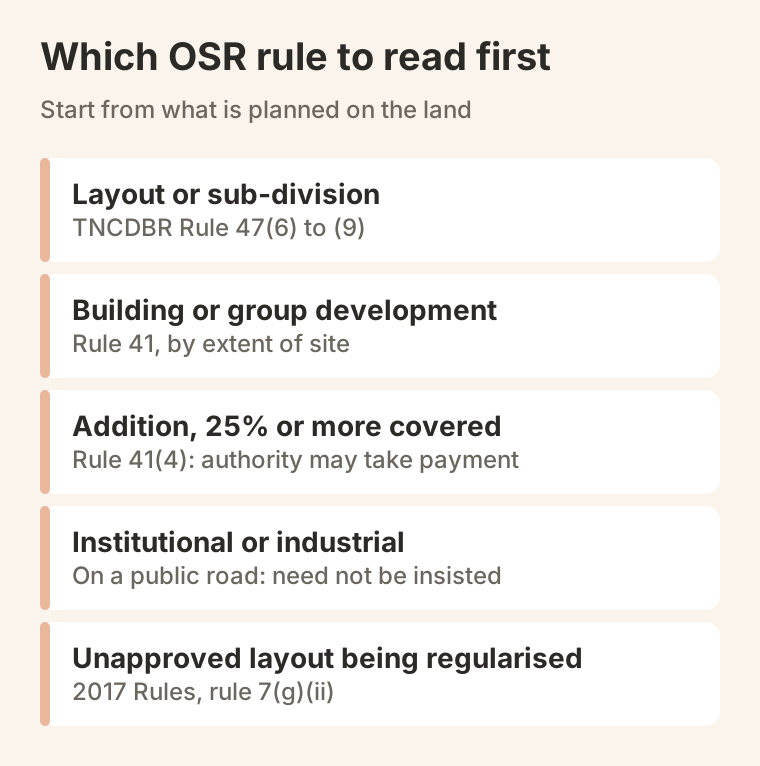
The development category, the other layout shares and any regularisation history also change what a site owes. The chart below shows which rule to read first.
How the land reservation is measured
The reservation is 10% of the area excluding roads. Rule 41(1) and Rule 47(6) both use that wording, so roads come out of the base before the 10% is applied. Using the gross plot as the base overstates the reservation and understates the saleable land.
That makes the road plan an input to OSR, not something you draw after. Change the road layout and the area excluding roads changes, and so does the land you keep open. Rules 41 and 47(6) do not say which passages count as “roads” for this deduction, and Rule 47(7)(a) separates roads that become public from those that remain private, so confirm with the authority which passages it treats as roads.
The reserved land must also be usable. Rule 41(1) asks for it at ground level, in a shape and location abutting a public road, as specified by the competent authority. Rule 41(2) says it is exclusive of the setback spaces and the spacing between blocks, and free from any construction. Setback space does not count towards OSR.
| Input | Where it comes from | Effect on the reservation |
|---|---|---|
| Extent of site or layout | Survey, patta and the registered deed chain | Sets the slab |
| Roads | The proposed layout or site plan | Deducted before the 10% is applied |
| Area excluding roads | Extent minus roads | The base for the 10% |
| Setbacks and spacing | The building plan | Cannot be counted as OSR |
| Category | Layout, building, addition, institutional or industrial, regularisation | Decides which rule applies |
Get the extent from records you have checked. The Patta-Chitta record and the Encumbrance Certificate show the extent as recorded, and a mismatch with the survey on the ground can move the slab as well as the base.
Paying instead of reserving land
Between 3,000 and 10,000 sqm, the owner may pay instead of reserving land. Rule 47(6) says the owner “shall pay the guideline value of equivalent land and excluding the first 3000 square metres as per the valuation of the registration department”. Rule 41(1)(b) uses almost the same words. Above 10,000 sqm there is no payment option for new developments, redevelopments or layouts. Additions to existing developments follow Rule 41(4), covered below.
The rules do not set out the arithmetic. The equivalent land is the land that would otherwise be reserved, which is 10% of the area excluding roads, and the first 3,000 sqm is excluded. One reading is 10% × (area excluding roads − 3,000 sqm) × guideline value. The text does not say whether roads come out before the 3,000 sqm is excluded, or exactly how the exclusion is applied. Ask the authority how it computes the payment, and get the figure in writing before you price the deal.
The choice between land and payment is a business call. Land given up is saleable area you never sell. Payment is cash spent before the first plot is sold. Run both in the same feasibility sheet and record why you picked one.
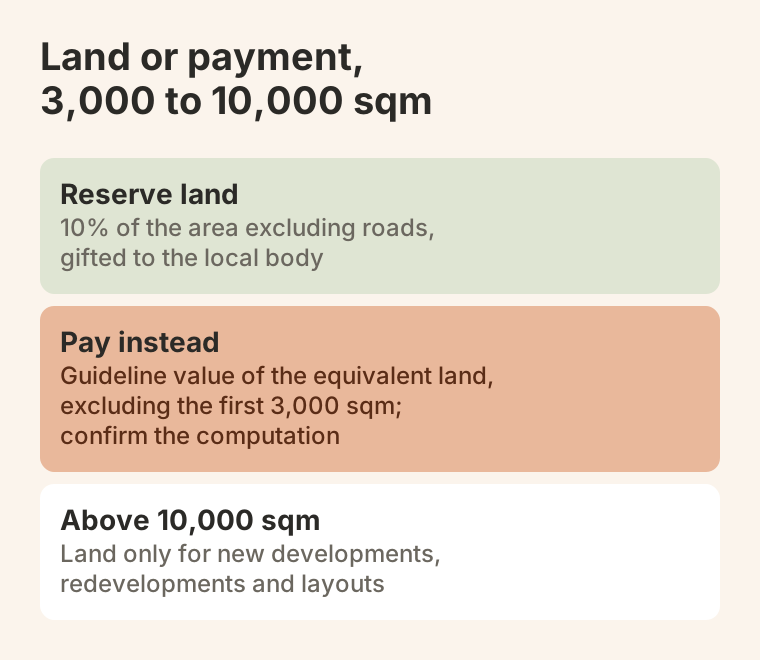
| Question | Reserve land | Pay instead |
|---|---|---|
| Which slabs | Above 3,000 sqm | Between 3,000 and 10,000 sqm, for new developments and layouts |
| Base | 10% of the area excluding roads | Guideline value of the equivalent land, excluding the first 3,000 sqm |
| What you give up | Saleable land | Cash |
| What drives it | The road plan | The guideline value for the land |
The guideline value is the Registration Department’s valuation, not the market price. Look it up in the Tamil Nadu guideline value lookup, and read the glossary entry on guideline value for what it does and does not mean. TNREGINET publishes the official rates on its portal.
Minimum size, width and number of parcels
Between 3,000 and 10,000 sqm, no reserved area may measure less than 100 sqm, with a minimum width of 10 m, and Rule 41(1)(b) allows at most two parcels. Rule 47(6) repeats the 100 sqm figure for layouts, with a minimum dimension of 10 m. Above 10,000 sqm, Rule 41(1)(c) asks for at least 500 sqm with a minimum width of 10 m; Rule 47(6) states no minimum for that slab.
The rules do not say what happens when 10% of the area excluding roads comes to less than the minimum. Rules 41 and 47 provide no automatic switch to payment. Rule 69(1) lets the Government relax any parameter where a clearly demonstrable hardship is caused, but that is a discretion, not a route to count on. If your numbers land below the minimum, raise it with the planning authority at feasibility, not after the plan is drawn.
| Slab | Minimum area | Minimum width or dimension | Number of parcels | Rule |
|---|---|---|---|---|
| Between 3,000 and 10,000 sqm | 100 sqm | 10 m | Not more than 2 | Rule 41(1)(b); Rule 47(6) |
| Above 10,000 sqm, developments | 500 sqm | 10 m | Not stated | Rule 41(1)(c) |
| Above 10,000 sqm, layouts | Not stated | Not stated | Not stated | Rule 47(6) |
Under Rule 41(6), and Rule 47(6)(c) for layouts, small structures such as a watchman’s booth or public toilet may be permitted with a total floor area of up to 5% of the OSR area in one place.
Gift deed and timing
Where land is reserved, it generally goes to the local body free of cost by registered gift deed: between 3,000 and 10,000 sqm when the owner chooses land, and above 10,000 sqm. For layouts, Rule 47(7)(a) requires the road space, except roads that remain private, and the 10% recreational area to be gifted “before the actual sanction of the layout”.
There are three variations. Under Rule 41(1)(b), in residential developments, the local body may permit a residents’ or flat owners’ association to maintain the reserved space as a park or playground. Under Rule 47(7)(b), the competent authority may let industrial estates developed by Government departments or agencies, including joint ventures, retain their roads and recreational spaces and maintain them. Under Rule 41(5), for developments of Government departments or agencies, the local body’s Executive Authority may enforce their maintenance of the reserved land or order it transferred free of cost.
The practical risk is timing. A gift deed needs clean title to the exact parcel, survey and subdivision numbers that match the layout plan, and a registration slot. If any of those is missing, the sanction waits. Start title work on the OSR parcel with the rest of the land. The glossary entry on sale deeds explains registered conveyance.
| Step | What to have ready |
|---|---|
| Mark the OSR parcel | A plan showing the parcel, its size, its width and its road frontage |
| Clear title to the parcel | The deed chain and a current Encumbrance Certificate |
| Draft the gift deeds | Survey and subdivision numbers matching the plan, for OSR and public roads |
| Register the deeds | Execution at the jurisdictional Sub-Registrar Office |
| Complete before sanction | Registered gift deeds in place before the actual sanction of the layout |
Other shares a layout must set aside
OSR is not the only share Rule 47 sets aside in a layout. Some are handed over to the local body; others stay with the owner but can be used or sold only for a stated purpose. A feasibility model that only deducts roads and OSR overstates the land you can sell freely.
Rule 47(8) reserves a further 1% of the layout area, excluding roads, for public purposes in all layouts: 0.5% to the local body and 0.5% to TANGEDCO or the local body, by registered gift deed before the actual sanction of the layout. A proviso added by G.O. Ms. No. 129 of 29 June 2026, published on 30 June 2026, relieves industrial layouts or estates developed by a Government department or agency of transferring the local body’s 0.5%, though the applicant must still reserve and maintain it. Rule 47(9) requires 10% of the layout area, excluding roads, to be developed as EWS plots in residential layouts above 10,000 sqm. These are not handed over: the owner or developer sells them, but only for that purpose.
| Share | Applies to | Base | How it is handled | Rule |
|---|---|---|---|---|
| Public roads | All layouts | As planned | Gift deed before sanction, except private roads | 47(7)(a) |
| OSR | Layouts above 3,000 sqm | 10% of area excluding roads | Gift deed before sanction | 47(6), 47(7)(a) |
| Public purpose | All layouts | 1% of area excluding roads | 0.5% to the local body, 0.5% to TANGEDCO or the local body | 47(8) |
| EWS plots | Residential layouts above 10,000 sqm | 10% of area excluding roads | Sold only as EWS plots | 47(9) |
| Commercial | Subdivisions of 20 hectares or more | At least 3% of total area | Reserved if the competent authority requires it | 47(10) |
OSR land still counts towards floor space. Rules 35 and 39 permit FSI benefit for land left for OSR wherever the competent authority insists on it, and in an approved sub-division the FSI benefit for the OSR area is permitted in proportion to the plot extent. Our FSI and FAR guide covers the floor space rules on the same site.
Buildings, additions, institutional and industrial sites
Single buildings are not exempt as a class. Rules 35(8) and 39(9) send building developments to Rule 41, which applies by the extent of the site. A building on a site up to 3,000 sqm owes nothing because of the nil slab, not because setbacks replace OSR. On a larger site the slabs apply, and the reserved land is exclusive of setback spaces.
Additions to an existing development have their own route. Rule 41(3) defines an existing development as one where structures already cover 25% or more of the site before the application. Under Rule 41(4), where it is difficult to leave 10% open on such a site, the local body’s Executive Authority “reserves the right to collect the guideline value of equivalent land” instead. That is the authority’s right, not the owner’s. If the owner later demolishes the existing structures and builds new ones, the full reservation applies.
Institutional and industrial developments changed in 2020. G.O. Ms. No. 16 (31 January 2020) substituted Explanation (i) to Rule 41(1): reservation for these developments “abutting a public road need not be insisted in order to provide flexibility to the owner”. The original 2019 wording, under which the owner kept and maintained the space instead of gifting it, no longer applies. For institutional and industrial sites that do not abut a public road, the amended rule gives no express relief, so confirm the position with the authority. Industrial layouts are a separate case under Rule 47.
| Category | Rule | OSR | Payment instead | Gift deed |
|---|---|---|---|---|
| Building or group development | 41, through 35(8) and 39(9) | By slab | Between 3,000 and 10,000 sqm only | Yes, if land is reserved |
| Addition to existing, 25% or more covered | 41(3) and 41(4) | By slab, unless payment is taken | At the Executive Authority’s option | Yes, if land is reserved |
| Institutional or industrial, abutting a public road | 41(1), Explanation (i) as amended in 2020 | Need not be insisted | Not applicable | Not applicable |
| Private layout, any use | 47(6) and 47(7)(a) | By slab | Between 3,000 and 10,000 sqm only | Yes, before sanction |
| Government industrial estate | 47(7)(b) and the 47(8) proviso | By slab | Between 3,000 and 10,000 sqm only | May retain and maintain, if permitted |
Old layouts, Annexure XX and the 2025 Supreme Court ruling
Two ideas circulate widely: that land older than the master plan is exempt “under Annexure XX”, and that the Supreme Court has confirmed it. Neither holds under the current rules.
In TNCDBR 2019, Annexure XX deals with swimming pools. The OSR table labelled Annexure XX belongs to CMDA’s Second Master Plan Development Regulations of 2008, where it covers special buildings, group developments and multi-storeyed buildings. TNCDBR has no OSR exemption for land that pre-dates a master plan. The date 5 August 1975 appears in Rule 16, but only to decide which land-use zoning applies to a layout plan approved before then in the Chennai Metropolitan Area.
The date does matter in one other place. Rule 8 of the 2017 Regularisation Rules, as substituted by G.O. Ms. No. 172 of 2017, deems unapproved layouts or sub-divisions formed before 5 August 1975 in the Chennai Metropolitan Area, before 29 November 1972 in rural areas and before 1 January 1980 in urban areas outside it to have been approved. Their roads and OSR area, if any, vest in the local authority. That is deemed approval of an old layout as it stands, not an exemption for new development on old land.
The Supreme Court ruling is CMDA’s appeal reported as 2025 INSC 1200, decided on 8 October 2025 and marked non-reportable. It applied the 2008 CMDA regulations to a 2,229 sqm hospital site. The Court upheld findings that the site had been a separate holding since before the First Master Plan came into force on 5 August 1975, and rejected the attempt to “recombine it notionally” with the larger parent estate. It held that the site fell in the nil slab for the first 3,000 sqm and noted that no layout had been formed. CMDA had to refund the OSR charge it had collected, with 8% interest.
The ruling does not exempt old layouts of any size, and it does not decide how the payment is computed above 3,000 sqm. Its lesson for land teams is narrower: documents that prove a site has long been a separate holding can stop an authority from adding it back to a larger parent area. In that case the evidence was a 1949 partition deed, gift deeds of 1972 and 1973 and separate pattas. Keep old partition deeds, gift deeds and pattas for that reason.
| What you may hear | What the texts say |
|---|---|
| ”Pre-1975 layouts are exempt under Annexure XX” | TNCDBR’s Annexure XX covers swimming pools, and TNCDBR has no age-based OSR exemption |
| ”The Supreme Court confirmed the exemption” | 2025 INSC 1200 applied the nil slab to one 2,229 sqm site and rejected notional aggregation |
| ”The ruling fixed the payment formula” | The ruling did not deal with payment above 3,000 sqm |
| ”Outside Chennai the cutoff is 1972 or 1980” | Those dates deem old unapproved layouts approved under the 2017 Regularisation Rules; they do not waive OSR on new development |
Regularisation of unapproved layouts
Unapproved layouts being regularised follow the Tamil Nadu Regularisation of Unapproved Layouts and Plots Rules, 2017, not the fresh-layout slabs. Under rule 7(g)(ii), as amended by G.O. Ms. No. 94 (Housing and Urban Development, 16 March 2024), 10% of the unsold plot area must be provided as OSR. Where the unsold plot area is up to 5,000 sqm, the applicant may instead pay an amount equal to 10% of the prevailing guideline value of the unsold plot area.
Plots already sold are treated differently. Rule 7(e)(v), added by G.O. Ms. No. 172 of 2017, regularises individual plots already sold in a layout or sub-division “with full exemption from the Open Space Reservation requirements”. The obligation falls on the unsold area of the layout, not on the buyer of a single plot.
Check whether the route is open before you plan on it. G.O. Ms. No. 13 (27 January 2026) let layout promoters apply on or before 30 June 2026, and individual plot owners at any time. Confirm with the authority whether it is still accepting layout applications. One detail to raise at the same time: rule 2(7) ties the guideline value for unsold plots to the date of in-principle approval of the layout framework, while the amended rule 7(g)(ii) says “prevailing” guideline value. Ask which date the authority uses.
| Question | Fresh layout under TNCDBR 2019 | Regularisation under the 2017 Rules |
|---|---|---|
| Base | 10% of the area excluding roads | 10% of the unsold plot area |
| Nil slab | First 3,000 sqm | No size slab; plots already sold are exempt |
| Cash option | Between 3,000 and 10,000 sqm | Unsold plot area up to 5,000 sqm |
| Cash amount | Guideline value of the equivalent land, excluding the first 3,000 sqm | 10% of the prevailing guideline value of the unsold plot area |
| Above the cash limit | Land only, above 10,000 sqm | Land only, above 5,000 sqm of unsold area |
Do not carry either formula into the other route: they share the 10% figure, but not the base, the slabs or the cash limits.
OSR in land acquisition due diligence
OSR changes what a parcel is worth to a developer, so it belongs in due diligence before the advance. The planning authority applies the rules: CMDA inside the Chennai Metropolitan Area, and DTCP or the local planning authority elsewhere. Applications go through the state’s online planning permission portal. Reserved land goes to the local body.
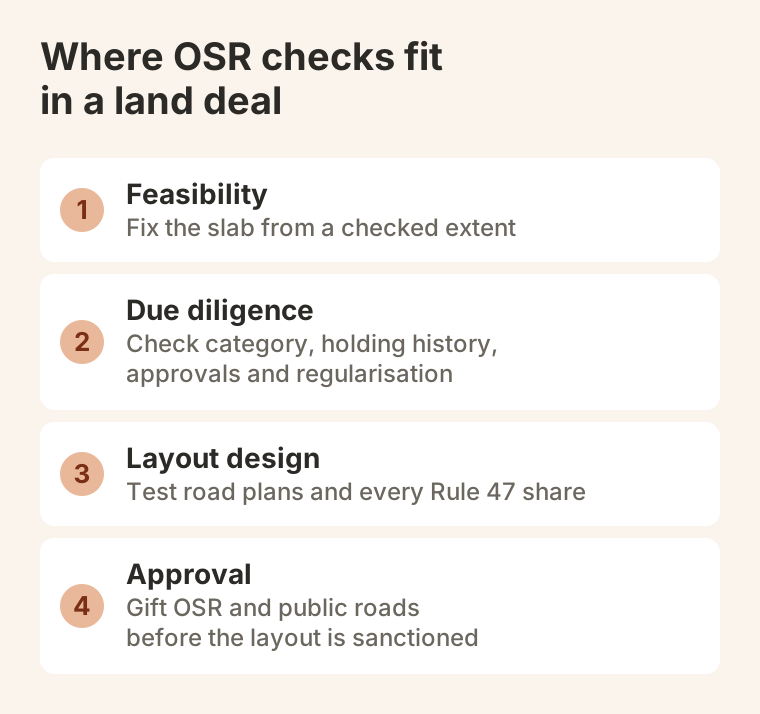
| Check | Record or source | What it settles |
|---|---|---|
| Extent | Patta-Chitta, FMB sketch and deed chain | The slab |
| What is planned | Layout plan or building plan | Rule 41 or Rule 47 |
| Roads | The proposed plan | The base for the 10% |
| Holding history | Old partition deeds, gift deeds, pattas | Whether the site is a separate holding |
| Road frontage and use | Site survey and the proposed use | Whether the 2020 institutional and industrial relief can apply |
| Prior approvals or regularisation | Planning authority orders | Whether OSR was already dealt with |
| Guideline value | TNREGINET | The payment in lieu |
| Existing coverage, for additions | Approved plans and site survey | Whether Rule 41(4) can arise |
If the land is agricultural, OSR is not the first gate. Read the land conversion record page and our guide to agricultural land conversion first. The land due diligence checklist covers the title checks that run alongside.
Common OSR mistakes
Most OSR errors are about the base and the category, not the 10% rate.
| Mistake | What the rules say |
|---|---|
| 10% of the gross plot | 10% of the area excluding roads |
| Counting setbacks as OSR | Reserved land is exclusive of setbacks and spacing between blocks (Rule 41(2)) |
| Paying in lieu above 10,000 sqm | Not accepted for new developments and layouts; the land must be reserved and gifted |
| No gift deed between 3,000 and 10,000 sqm | Wherever land is reserved it is gifted, for layouts before sanction, subject to the stated exceptions |
| Treating single buildings as exempt | Rule 41 applies to buildings by the extent of the site |
| Assuming old land is exempt | TNCDBR has no age-based exemption; old deeds help prove a separate holding |
| Citing Annexure XX of TNCDBR for OSR | Annexure XX of TNCDBR deals with swimming pools |
| Using regularisation rules on a fresh layout | The 2017 Rules apply only to regularisation |
| Deducting only roads and OSR in a layout | Also deduct the 1% public purpose share; in residential layouts above 10,000 sqm, price 10% as EWS plots, sold only for that purpose |
| Treating guideline value as the price | It is the Registration Department’s valuation, not the market price |
What this means for you
Deal with OSR before the term sheet. Each party in a deal sees it differently.
Land owners: OSR is not a charge on you while you hold the land, but it shapes what a developer will offer. Know the extent, whether the land is likely to be laid out or built on, and whether it abuts a public road. Keep the old partition deeds, gift deeds and pattas, because they show how long the land has been a separate holding.
Buyers: if you are buying a plot in a layout, ask whether the layout was approved or regularised, and where its open space is. A layout without a marked open space, where the rules required one, is a question for the seller before you pay. If it was regularised, ask for the order: plots already sold were exempt, and the 10% fell on the unsold area, as land or, up to 5,000 sqm of unsold area, as a payment.
Developers: model land and payment side by side between 3,000 and 10,000 sqm, test road plans against the area excluding roads, and account for every Rule 47 share, not only OSR. Allow time for the gift deeds before sanction. Use the OSR calculator and the FSI calculator for first estimates, and confirm the authority’s figures before you commit.
Sources and editorial notes
Methodology
Every rule statement was read from the Tamil Nadu Government Gazette: TNCDBR 2019 as notified, and the amendments to Rules 41 and 47 found in a sweep of the Extraordinary Gazette indexes for 2019 to 2026. The regularisation rules and the 2025 Supreme Court judgment were read in full. Where a rule does not spell out a computation, the guide says so instead of supplying one. Weekly Gazette issues were not swept for amendments to Rules 41 and 47, so confirm the current text with the planning authority.
Sources
- Tamil Nadu Combined Development and Building Rules, 2019 (G.O. Ms. No. 18, MAWS, 4 February 2019), Gazette Extraordinary No. 43 — Government of Tamil NaduPrimary source · Checked Rules 16, 35, 39, 41 and 47 and Annexure XX as notified
- Amendments to TNCDBR 2019 (G.O. Ms. No. 16, MAWS, 31 January 2020), Gazette Extraordinary No. 41 — Government of Tamil NaduPrimary source · Checked Rule 41(1) Explanation (i) substituted; rule 47(7)(b), 47(8) and 47(9) amended
- Amendment to TNCDBR 2019 (G.O. Ms. No. 129, HUD, 29 June 2026), Gazette Extraordinary No. 300 — Government of Tamil NaduPrimary source · Checked Proviso to rule 47(8) for Government industrial layouts and estates
- Amendments to the Tamil Nadu Regularisation of Unapproved Layouts and Plots Rules, 2017 (G.O. Ms. No. 172, HUD, 13 October 2017), Gazette Extraordinary No. 327 — Government of Tamil NaduPrimary source · Checked Rule 7(e)(v) added; rule 7(g) and rule 8 substituted
- Amendment to the Tamil Nadu Regularisation of Unapproved Layouts and Plots Rules, 2017 (G.O. Ms. No. 94, HUD, 16 March 2024), Gazette Extraordinary No. 117 — Government of Tamil NaduPrimary source · Checked Rule 7(g)(ii) open space reservation and the 5,000 sqm cash option
- Amendments to the Tamil Nadu Regularisation of Unapproved Layouts and Plots Rules, 2017 (G.O. Ms. No. 13, HUD, 27 January 2026), Gazette No. 6 — Government of Tamil NaduPrimary source · Checked Rule 25 application dates for layout promoters and individual plot owners
- Chennai Metropolitan Development Authority v. Dr. Kamala Selvaraj, 2025 INSC 1200 (8 October 2025) — Supreme Court of India, judgment text reproduced by Indian KanoonPrimary source · Checked Non-reportable judgment; read in full
- Second Master Plan for Chennai Metropolitan Area, 2026: Development Regulations (Volume II) — Chennai Metropolitan Development AuthorityPrimary source · Checked Annexure XX of the 2008 CMDA regulations, applied in the 2025 ruling
Questions
Work out the open space reservation for your layout
Enter plot area, internal roads, category and guideline value to see the OSR tier, land carve-out and fee in lieu.
Continue reading
FSI and FAR in Tamil Nadu: Developer Guide to the TNCDBR 2019 Rules
How much you can build on a Tamil Nadu plot under TNCDBR 2019: FSI by road width, premium FSI cost, OSR, ground coverage, Metro discount and CMDA vs DTCP.
Joint Development Agreement in India: Due Diligence Checklist
What a land team should check before signing a JDA in India: title chain, EC scope, revenue records, FMB, planning approvals and Tamil Nadu registration rules.
Patta Mutation in Tamil Nadu After a Purchase: Steps, Fee and Time
How to change the Tamil Nadu patta to your name after a registered purchase: e-Sevai routes, the listed ₹60 charge, and the 15 and 30 day disposal figures.